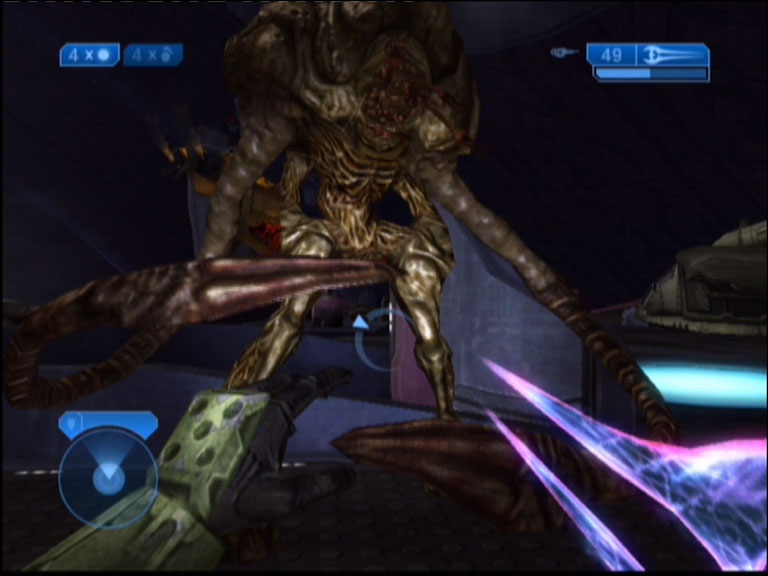
Halo 3 is just around the corner and I bit the bullet and upgraded the Xbox to an Xbox360. I also preordered the game and my son and I started going back through Halo and Halo 2 to refresh our memory about the storyline (I know, I know, I'm technically a bad dad in that those games are recommended for mature audiences only...)
That aside, though, my son has been more interested in the backstory of those games than in almost anything else (and he reads extensively). Partly, I attribute that interest to the vagueness of the story exposition in the games, leaving much to imaginatively fill-in. But, also, his interest arises because of the dual embedded themes of the Covenant and Flood in the game. He sees parallels between the religious war of the Covenant and current events, but his interest in the Flood keeps popping up with an odd intensity.
For those who are not Halo fans, the Flood is a parasitic organism that constructs Frankensteinian golems out of body parts. The relation to the alien Covenant is that the Halo (ringworlds) devices were created by an ancient civilization to periodically destroy all life in the universe and cleanse the universe of the Flood, but the Covenant believes that they will send them on The Long Journey if they activate them, paralleling the nihilism of extreme jihadists, in a way.
The Flood, as a parasite, caused my son initial consternation but has also brought about some amazing discussions, including one today during lunch. My wife and I were explaining how viruses were not intelligent but were creatures that simply survive and do not really have a purposeful origin. They are not really malevolent, either, and perhaps the Flood are similar. Malevolence is an attribute that we ascribe to intentionality and parasites are not intentional.
We emphasized a spectrum of lifeforms and described how, for instance, ants have individual nervous systems and also use chemical messages to communicate threats and food sources, and also how, unlike viruses, ants are unique in that only the queen reproduces and so the workers do not derive their individual purpose from reproduction alone, but from supporting the queen in reproducing.
Finding the language to explain this to a nine-year-old was surprisingly difficult, I found. The very idea of non-intentionality combined with intrinsic purpose is remarkably outside our language and intuitive framework of explanation. Children think stuff happens either because it is a mindless, natural phenomena or because it is a result of intentional action. Cats and dogs are intentional. Sunlight and waves are not. Getting into the middle world of what Ernst Mayr called teleonomic (appearing purposeful due to an adaptive algorithm) is surprisingly non-conforming to everyday ideas.
Still, my son was intrigued by the idea that children think so oddly about the world. During our discussion, a sea plane taxied by on the water outside and disrupted the conversation with sheer coolness. We wandered the docks outside the restaurant afterwards and got to peer in the cockpit. Strapped to the pilot's yoke was an aftermarket GPS unit, helping him fly with precise intentionality.


 The Uncanny Valley.